Introduction
When people compare context engineering vs prompt engineering, the clean difference is this: prompt engineering is how you word the ask; context engineering is what you put in front of the model before it answers. The model is just the model; your context is the source of truth.
Most people spend their time tweaking the 5 percent, prompt wording, and ignore the 95 percent, the files, rules, examples, data, and constraints that actually shape the output. This piece breaks down what each one is, where each one wins, and the practical two-phase system that gets better results without relying on prompt gymnastics.
Estimate token API costs for free ⇒
The One-Line Difference
Prompt engineering is about phrasing the request well. Context engineering is about shaping the full information environment the model uses before it writes a single word.
If you only improve the prompt, you improve one ask. If you improve the context, you improve every ask that follows.
Prompt engineering in one sentence
Prompt engineering is the practice of crafting how you word a single ask, including the instruction, structure, and examples, so the model gives a better answer.
Context engineering in one sentence
Context engineering is the practice of building and managing what the model sees before it answers, including voice, offers, data, memory, and available tools.
Prompt engineering is a subset of context engineering.
Context Engineering vs Prompt Engineering at a Glance
Prompt engineering and context engineering can overlap, but they solve different parts of the problem. The cleanest difference is scope: one improves a request, the other improves the whole setup the model is working inside.
The bigger gap is reusability. A better prompt can help one exchange, while better context can keep improving every future exchange built on the same source of truth.
| Dimension | Prompt Engineering | Context Engineering |
|---|---|---|
| Effort location | The sentence | The folder |
| Scope | Single query | Whole information system |
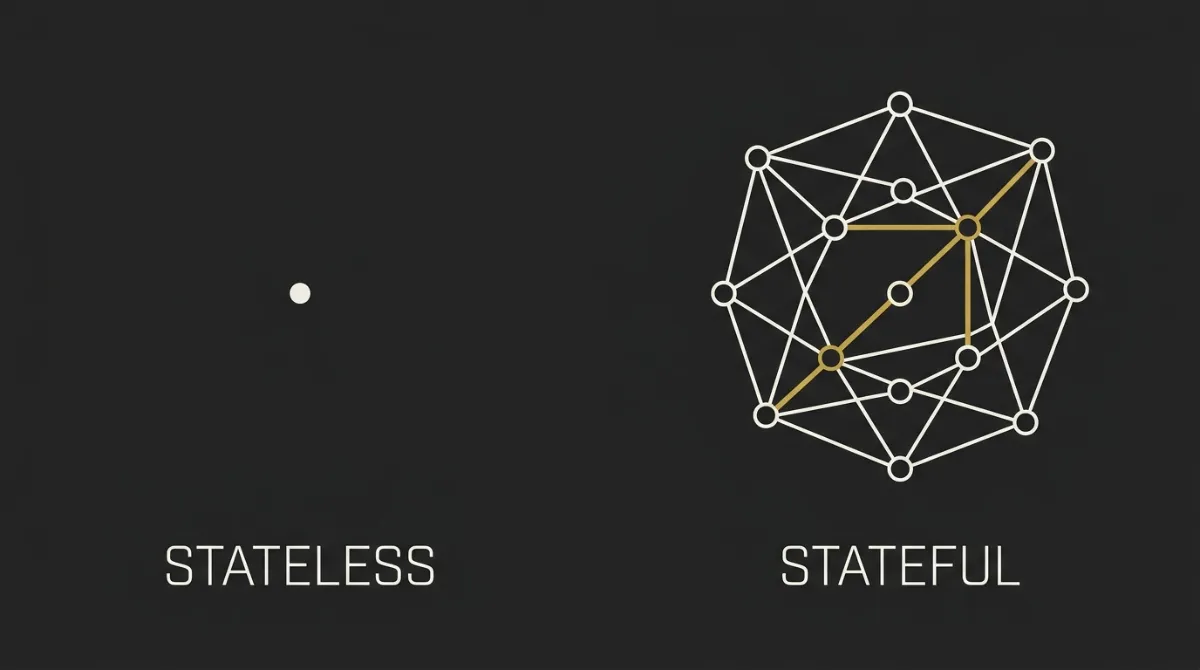
| State | Stateless | Stateful, persistent |
| Reusability | One-off tweaks | Compounds across every session |
| Failure mode | Ambiguity | Missing, wrong, or overloaded context |
| Ceiling | Plateaus as models improve | Scales with your knowledge base |
| Best for | Quick one-offs | Reliable multi-turn systems |
What Prompt Engineering Actually Is
Prompt engineering is the practice of designing the instruction itself so the model knows what to do, how to do it, and what shape the answer should take. It still matters, especially when you need a fast, clean response from a single interaction.
The classic toolkit
Role framing means telling the model what perspective to take before it answers. For example, asking it to respond as a technical editor will usually produce a different answer than asking it to respond as a sales rep.
Output structure and format control means specifying the shape of the response up front. For example, you can ask for a two-column table, a JSON object with fixed keys, or a three-step checklist instead of a loose paragraph.
Few-shot examples means showing the model a small sample of the kind of input-output pattern you want. For example, if you provide two examples of messy notes turned into polished summaries, the model is more likely to follow that pattern on the third one.
Reusable placeholders and templates means building prompts with slots you can swap in each time. For example, a template like audience + goal + constraints + output format is easier to reuse across many requests than rewriting the full instruction from scratch.
Why it hit a ceiling
Prompt engineering hit its limits because newer models already follow plain instructions much better than early ones did. That means the gain from clever wording is often smaller now, especially once the task is already described clearly.
The second issue is brittleness. Once you keep stuffing edge cases, exceptions, and backup rules into one prompt, it starts to act less like a clean instruction and more like a patchwork document that can break when the task changes slightly.
That is why prompt engineering still has value, but usually as an optimization layer, not the whole system. If you want the full picture on inputs, token load, and model budget, see our AI token cost calculator.
What Context Engineering Is

Context engineering is the work of deciding what the model should know before it answers. It is less about writing a smarter sentence, and more about building the source material the model can actually reason from.
Why AI is stateless by default
AI is stateless by default, which means each new session starts with no memory of your brand, your offers, your audience, or your past decisions. If you re-brief it from scratch every time, it fills the gaps with generic defaults, and the output usually sounds generic too.
That is why single-session prompting breaks down fast in real work. The model may follow the instruction, but without persistent context it has no stable reference point for what is true, relevant, or on-brand.
Building the persistent source of truth
Context engineering is the deliberate job of assembling what enters the context window before the model responds. That usually includes brand voice, offers, audience, USPs, real data, memory, and the definitions for any tools or actions the system can use.
The cleanest way to think about it is this: the model is just the model; your context is the source of truth. When that source of truth is structured and persistent, the model stops guessing as much and starts operating inside a clearer system.
In practice, that persistent layer can look like a brand folder, a ruleset, a memory store, or another controlled source that carries forward across sessions. For the full picture on how input size affects model usage, see our AI token cost calculator.
Where No Context Sends the Model
With no context, the model does not ground itself on you. It grounds itself on the open web, which usually means the same recycled patterns, claims, and phrasing already sitting across your category, including your competitors’ content.
That is why so much AI output sounds interchangeable. If your source of truth is not your own folder, your own data, and your own point of view, the model defaults to the average of what it can infer, and average in means average out.
Why Context Wins Now: The Context Window Argument
Larger context windows changed the math. This is why context now out-scales clever prompting: you can load far more of the business brain into one session, and every output in that session inherits from it.
Usable brand context per session
Top models can hold roughly 10 to 50 files of brand material in one session, which turns scattered business knowledge into live working context.
Inherits the same grounding
Once that context is loaded, each answer in the session pulls from the same voice, offers, decisions, and history instead of starting cold each time.
Recall does not scale the same way
A human writer could not reliably hold that volume of business context in mind for every single piece without missing details or drifting in tone.
Bigger windows still need curation
More room does not mean dump everything in. Too much, conflicting, or messy context lowers relevance and can reduce answer quality.
The Two-Phase Context Engineering Workflow
Context engineering gets practical when you treat it like an asset, not a trick. The pattern is simple: build once, then reuse that source of truth every time the model works.
Phase 1: Build the context folderBuild once
Create one dense source of truth the model can keep returning to instead of re-briefing from scratch every session.
- Capture brand voice, including tone rules, phrases to keep, and phrases to avoid.
- List core USPs and offers, so the model knows what you actually sell and how you position it.
- Define the audience clearly, including who the content is for and what they care about.
- Add real data and research, not generic claims, so the model has facts to work from.
- Structure everything into one organized folder that is built once and updated when the business changes.
Verify this outcome: voice consistency. The model should sound like the brand, not like a random AI default.
Phase 2: Run AI grounded only in that folderReuse forever
Use the folder as the working base every time, so the model reasons from your material instead of drifting toward generic web patterns.
- Attach the folder as context at the start of each session.
- Keep the model grounded in that material rather than letting it pull from open-web assumptions.
- Generate the draft, outline, analysis, or asset from that controlled context.
- Review the output before shipping, especially for factual accuracy and brand fit.
Verify this outcome: no drift. The output should stay aligned with your brand, your offers, and your real information across repeated sessions.
For the full resources, see Marcus-Aurelius Digital.
Where Prompt Engineering Still Matters
Prompt engineering still matters, but it works best inside a strong context base. Prompting is the finishing move; context is the foundation.
Front-load context and define output structure
Even with a strong context folder, you still need to front-load the relevant context into the prompt so the model knows which part of the source of truth matters for this task. Then you define the output shape clearly, whether that is a table, checklist, JSON object, short summary, or draft in a specific format.
This is the practical balance: prompting lives inside context. A good prompt does not replace the source of truth, it tells the model how to use that source of truth for the job in front of it.
Self-audit your prompts
Good prompting also includes pressure-testing the model after it answers. One of the simplest habits is asking it, why A and not B?
That question often exposes weak reasoning, hidden assumptions, or a missed detail the model glossed over on the first pass. Context lowers the error rate, but prompt-level self-auditing is still how you catch drift before the work ships.
The Real Skill Underneath Both: Taste
Tool fluency is getting cheaper by the month. Prompt patterns are getting copied, automated, and bundled into products, but the ability to judge whether something is actually good enough to ship is still rare.
Taste is the line between acceptable and excellent, and the discipline to refuse to publish until it clears that line. Context engineering lowers the error rate, but taste decides what ships, and no model setting can do that job for you.
Stop Collecting Prompt Hacks, Build Context Once
If the task is one-off, prompt engineering is usually enough. If the task repeats, touches brand judgment, or needs reliable output over time, build the context once and keep reusing it, because that is what turns AI from a clever assistant into a dependable system.
Context-heavy sessions also mean more tokens, so it is worth keeping an eye on cost as your setup grows. As a simple next step, estimate your AI token costs instantly with the free AI Token Calculator, then bookmark it for the next time you load a full context folder.
Frequently Asked Questions
Is prompt engineering dead?
No, prompt engineering is not dead. It is still useful for one-off tasks, quick experiments, and situations where you only need a single good answer rather than a repeatable system.
What changed is its role. In more complex AI workflows, prompting is now better understood as one part of a larger context strategy rather than the whole game.
Is prompt engineering a subset of context engineering?
Yes, in modern AI systems prompt engineering is best understood as a subset of context engineering. Prompting shapes how you ask, while context engineering shapes what the model knows when you ask it.
That means the prompt is still important, but it operates inside the context you built. The wording matters, but the surrounding information architecture matters more.
What is the difference between context and a prompt?
A prompt is the wording of a single instruction or request. Context is the full set of information the model has available before it answers, which can include system instructions, memory, tools, data, and prior messages.
Put simply, the prompt is the ask. The context is everything the model knows when it tries to answer that ask.
Do bigger context windows remove the need for context engineering?
No, bigger context windows do not remove the need for context engineering. More room helps, but dumping more unstructured tokens into the window can still dilute attention and lower answer quality.
This is the core issue behind context rot. A larger window gives you more capacity, but you still need to decide what belongs in it and what should stay out.
What skills does a context engineer need?
A context engineer needs more than prompt writing. The skill set usually includes prompting, retrieval or indexing logic, memory strategy, tool schema design, and the judgment to decide what information should be present at each step.
Taste matters too. Even with strong context and a solid prompt, someone still has to judge whether the output is accurate, useful, and good enough to ship.