
Introduction
In plain English, context engineering in prompt engineering is the shift from writing a clever instruction to building the full briefing behind it. The prompt is the sentence you type, but the context is everything wrapped around it: system instructions, tools, memory, structured inputs, and the relevant information the model needs to do the job properly.
This piece breaks down what context actually is, where it sits inside prompting, and why the term matters more now that AI workflows are moving beyond one-off prompts into multi-step systems. It also walks through a concrete example so the prompt versus context split feels obvious, not abstract.
Context Engineering in Prompt Engineering Explained
The one-line answer
Context engineering is the practice of deliberately building and managing everything an AI model sees in its context window before it produces anything. Prompt engineering is how you phrase the request; context engineering is what the model already knows when it reads that request.
This matters because good output usually comes from better context, not just longer prompts. If you want a practical example of how token limits shape that setup, estimate AI token costs before you start stuffing more material into the window.
Prompt vs context at a glance
The prompt is the wording of the ask. The context is the source-of-truth material around that ask, such as system instructions, structured inputs, memory, tools, and relevant history.
That is the clean split. The full comparison table comes next.
Prompt Engineering vs Context Engineering
Prompt engineering and context engineering are not competing ideas. Prompting sits inside context engineering, because the wording of the request is only one part of what the model actually sees and uses.
The cleaner way to think about it is simple: prompt engineering shapes the ask, context engineering shapes the full working environment around that ask.
| Dimension | Prompt Engineering | Context Engineering |
|---|---|---|
| Unit of design | Single prompt or instruction block | Full context window |
| What it controls | How you ask | What the model knows |
| Scope | One interaction | Ongoing system |
| State | Usually stateless | Often stateful |
| Knowledge source | Embedded in the prompt | Retrieved, selected, and managed across inputs |
| Best for | One-off tasks | Reliable multi-step agents |
Read this table top to bottom and the relationship becomes clear: prompt engineering is one design layer inside context engineering work, not a replacement for it.
Where Context Engineering Sits Inside Prompt Engineering
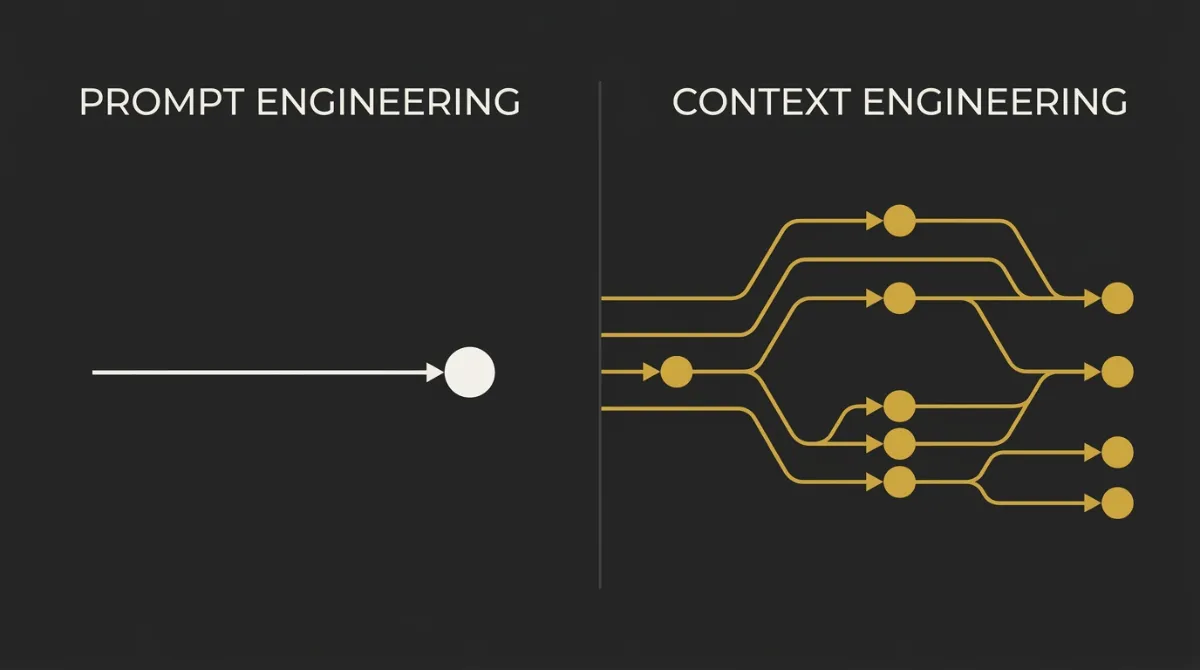
The prompt is the sentence. Context engineering is the briefing behind it. Prompting shapes how the model is asked, but context engineering determines what the model knows before it starts and what information is even available for the answer.
That is why context sits upstream of prompting. The prompt is one layer inside a bigger assembly pipeline that can include system instructions, memory, structured inputs, tools, prior messages, and retrieved material.
A weak prompt with the right context can still do useful work. A polished prompt with missing or stale context will still produce thin output. Context is the bigger lever.
Prompting is the finishing move
Prompting matters because wording still affects clarity, constraints, tone, and task structure. But it acts at the end of the setup, once the model has already been placed inside a certain working environment.
Think of it like this: prompt engineering tells the model what you want done right now. Context engineering tells it who it is helping, what rules apply, what facts matter, and why this task should be answered in a specific way.
Context is the foundation
Context engineering is the foundation because it decides the source-of-truth material the model can draw from. That is the difference between asking an AI to write cold from defaults versus asking it to work from the right instructions, the right files, and the right history.
This is also where AI token costs become practical, not theoretical, because every extra instruction, memory block, and retrieved document takes up room in the context window. If you want reliable outputs, manage the context first, then write the prompt.
What Context Actually Includes
Context is much bigger than a prompt. A model can see instructions, prior messages, retrieved material, tool definitions, output constraints, and sometimes a source-of-truth brand folder that keeps voice, pricing, positioning, and past work consistent.
The practical point is simple: if the context is thin, stale, or messy, the output usually follows. The matrix below shows the main pieces that can sit inside the model’s working environment at inference time.
| What it is | Why the model needs it | Example |
|---|---|---|
| System prompt / instructions | Sets the model’s role, rules, priorities, and boundaries before the task starts. | You are a support agent, answer in US English, do not invent refunds or policies. |
| User prompt | Defines the immediate task or question being asked right now. | Summarize this product page for a first-time buyer in 3 bullets. |
| State & history (short-term memory) | Keeps the current conversation coherent across turns and prevents the model from restarting every reply from zero. | The user already shared their stack, clarified the audience, and rejected one draft direction earlier in the chat. |
| Long-term memory | Stores durable facts worth reusing across sessions, as long as they stay relevant and clean. | Preferred writing style, recurring workflows, approved terminology, or stable client preferences. |
| Retrieved info (RAG) | Pulls in specific documents or data the base model would not reliably know on its own. | Internal docs, help-center articles, product specs, meeting notes, or policy pages loaded for this task. |
| Tool definitions | Tells the model what external actions or data sources it can call and how those tools fit the task. | A calculator, database lookup, search tool, CRM action, or document retriever available during the run. |
| Structured output format | Constrains the shape of the answer so the output is usable downstream. | Return valid JSON with fields for title, summary, confidence, and next_step. |
| Brand source-of-truth (voice, pricing, positioning, past work) | Anchors the model in real business facts so it does not fill gaps with generic defaults. | A brand folder with voice rules, services, pricing, proprietary data, case studies, positioning, and approved opinions. |
Why the Term Context Engineering Exists Now
The term took off because models got much better at following instructions, so the bottleneck moved. The hard part is no longer just writing the request, it is deciding what information, history, constraints, and source material the model should see before it answers.
That shift matters because more context is not automatically better context. Attention is finite, stale material piles up, and context rot kicks in when the window fills with irrelevant or outdated tokens instead of the few things that actually matter.
Models already follow instructions well
Modern models are usually good enough at understanding plain instructions. If the output is still weak, the problem is often not the wording, it is that the model was asked to work with missing facts, weak history, or no real source-of-truth material.
This is also why generic AI content happens so easily. Give the model no context, and it fills the gaps with training defaults.
The leverage moved to what you feed them
The better reframe is simple: the model is just the model, your context is the source of truth. In practice, a mid-tier model with strong context often beats a frontier model with none, because the better-fed model has the right facts, the right voice, and the right constraints from the start.
That is why context engineering now feels like the bigger discipline. People are not just writing prompts anymore, they are designing the full input system that keeps multi-step work accurate, consistent, and grounded.
How Context Engineering Works in Practice

Retrieval and construction
The first job is retrieval: pull in the information the model does not already have, or cannot be trusted to recall accurately. That can mean documents, database records, tool outputs, product specs, prior messages, or other external material. Good context engineering does not dump everything in, it builds the smallest set of high-signal tokens that maximizes the desired outcome.
Processing and compression
Once the material is gathered, it has to be cleaned up, ranked, and compressed so the useful parts survive. Raw context often contains duplicates, stale notes, side trails, and low-value filler, which is how context rot starts. The practical goal is simple: preserve the facts, constraints, and decision-relevant details, while stripping everything that does not help the next answer.
Memory and state management
Memory management is the difference between what matters right now and what should persist later. Short-term memory lives inside the active session or context window, while long-term memory stores durable facts that should carry across sessions, such as stable preferences, approved rules, or source-of-truth business details. The best systems use clear write and read policies, so temporary task noise does not get promoted into permanent memory and poison future runs.
A Concrete Example: The Brand Folder
A brand context folder is context engineering in a form you can actually reuse. Instead of re-explaining the business every session, you build one source-of-truth package once and attach it at the start, so the model starts informed instead of guessing.
That is what makes the workflow repeatable. The model already has the brand context, so there is no manual re-briefing and far less drift from one session to the next.
Build one master folder once
Store the durable source-of-truth material in one place: voice rules, services, pricing, positioning, proprietary data, and past work. Keep it clean and high-signal, not a junk drawer of every random note.
Attach it at the start of every session
Load that folder into the model before asking it to do real work. This removes the need to re-brief the same business facts every time and keeps outputs far more consistent across sessions.
Generate from the folder, not from generic defaults
Ask the model to work from the supplied material instead of drifting into broad web-summary mode. That is the difference between branded output grounded in real inputs and generic content filled in from training data.
Review before you trust the output
Good context lowers the error rate, but it does not eliminate errors. Check the draft, interrogate the reasoning, and ask why the model made key choices before you publish or hand anything off.
Why Prompting Alone Breaks Down at Scale
Common failure points
Prompt-only workflows start clean, then get ugly fast: prompts grow bloated, the model loses earlier details, tool use becomes inconsistent, and the output drifts back to generic filler. Once the context window fills with stale history and too many mixed instructions, adding more words often makes the result worse, not better.
When you need context engineering
You need context engineering when the work is multi-step, runs over longer time horizons, depends on current or proprietary data, or needs consistent rules across sessions and tools. The sharp reframe is this: most agent failures are context failures, not model failures.
Key Takeaways
Prompt engineering improves how you ask, but context engineering improves what the model can actually reason from, and that is the bigger lever once the work moves beyond one-off prompts. If you are doing multi-step AI work, the quality of the context window usually matters more than polishing one more sentence in the prompt.
TL;DR: Prompt engineering optimizes the ask, context engineering optimizes the model’s working knowledge, and if you want more reliable outputs at scale, context is the bigger lever.
For a practical next step, you can estimate your AI token costs instantly with the free AI Token Calculator and bookmark it, since better context work still means keeping an eye on per-session token usage.
Frequently Asked Questions
Is prompt engineering a subset of context engineering?
Yes. Prompt engineering sits inside context engineering because the prompt is one part of the full information environment the model uses to answer.
Context engineering covers the broader setup: instructions, memory, retrieved data, tools, state, and output constraints. Prompting still matters, but it is one layer in that larger system.
What is the difference between a prompt and context in AI?
A prompt is the wording of a specific request. Context is everything the model sees before responding, including system instructions, prior messages, retrieved documents, tool definitions, and formatting rules.
In short, the prompt is the ask. The context is the working environment behind the ask.
Is context engineering replacing prompt engineering?
No. Context engineering is not replacing prompt engineering, it is reframing it as part of a bigger discipline.
You still need clear prompts, but strong outputs now depend just as much on the quality of the surrounding context. The prompt matters, and the context it sits inside often matters more.
Do I need context engineering for a simple chatbot?
Not always. For simple single-turn tasks, a well-written prompt is often enough.
Context engineering becomes more important when the chatbot needs memory, current information, tool use, multi-step behavior, or consistent answers across longer sessions. That is where prompt-only setups usually start to break.
What skills does a context engineer need?
A context engineer needs skill in retrieval, memory strategy, structuring information, defining tool use, and evaluating whether the context actually improves outcomes. The job is not just writing instructions, it is deciding what the model should know, what it should ignore, and what should persist over time.
The practical skill is curation. Good context engineering means selecting the right tokens, not just adding more of them.